The first time I encountered gliders levitated and controlled by an invisible wave of deflected air, it felt like magic! Surely this was going to take the world by storm, the way Mentos and Soda swept the world as a science activity a few years ago. But while researching the history of walkalong gliders, I was surprised to learn that the concept of surfing the gliders is decades old. Knowledge about them was cloistered within a few aerospace engineering and hang glider communities—definitely not in schools.
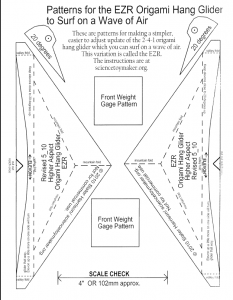
As an educator, I set about to make walkalong gliders accessible to regular people as a fun science activity by developing thin (1/2 mm) foam gliders that are an order of magnitude lighter than paper. Only a few times denser than air itself, they fly so slowly that beginners have time to think and react. If I walked beside you and we both held onto the board, then you could learn to fly in minutes because that way you gain a feel for flying. Soon you would be swooping around your house flying as easily as you ride a bicycle.
And the thin foam gliders are so efficient that advanced pilots (with practice) can levitate them with only their hands deflecting the air! The foam sheets are inexpensive to buy or slice your own--no one is excluded for lack of money. I find that kids around the age of 10 start having enough coordination to fly them.
So NOW the activity is going to catch fire, right? No. Any knucklehead can drop Mentos in soda, but walkalong gliders demand more. You don’t need to be flight savvy to start, but you have to pay attention to details. For one thing, the thin, light foam is also very delicate. The gliders won’t break from crashing into walls, but careless/nervous hands will wreck them in seconds. Even adults lack an analog for handling something that carefully--unless they’ve cuddled with a pet butterfly. Furthermore, the gliders need dead-still air, which usually means not outside except at dawn and dusk. Even aggressive HVAC systems and cause too much air turbulence inside. And although I can easily show people how to fly, being the first in your region with nobody to show you is more difficult.
Flying an already-made glider is the best way to begin and all packages come with a couple of RTF (ready to fly) gliders. This video shows the best way I know of how to learn.
Using gliders made from thin, low-density EPS (expanded polystyrene) is the best way to get started. Foam is extremely lightweight and slow-flying, so you have time to think and react. Thin sheets of EPS foam are much lighter and more rigid than paper, and inexpensive, too. Get gliders and foam here.
I consider myself very fortunate to live in a time when walkalong flight is spreading throughout the world and morphing into different forms. It's been exciting to sniff out the creation stories of how it began and branched. When students learn how to surf a glider on a wave of air they can also discover the fascinating stories of real people as they experienced that spark of invention. Just as importantly, they can see the foundations upon which discoveries are built, how people who make great discoveries tend to be interested in lots of different things, how they communicate with experts, how serendipitous accidents happen, and how years can pass before an idea reaches fruition. This is good stuff!
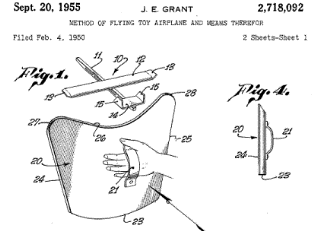
Joseph E. Grant invented walkalong gliding in 1950. And now we can learn from his daughters and son about this fascinating man.
At the age of 13, Tyler MacCready invented walkalong gliding again in the late 1970s and manufactured gliders.
Michael Thompson invented very thin, very slow-flying foam walkalong gliders.
David Aronstein invented planes with tails that fly as walkalong gliders.
John Collins, AKA The Paper Airplane Guy, invented the tumbling wing branch of walkalong gliding.
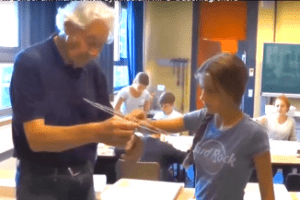
Thomas Buchwald, a Technik teacher in Germany, has innovated bionic gliders, materials and processes.
Phil Rossoni invented a paper walkalong glider and has shown how they work and how to fly.
Back in the 1980s Gordon Pollock made and sold the Wonder Wing with a brilliant canard.
Noel Eberhardt developed an effective folding jig that makes it much easier to make walkalongs with groups
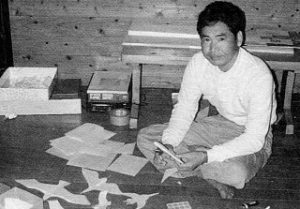
Kouyou Nagamatsu invented and wrote a book about thin-sliced foam for whimiscal gliders in 1996.
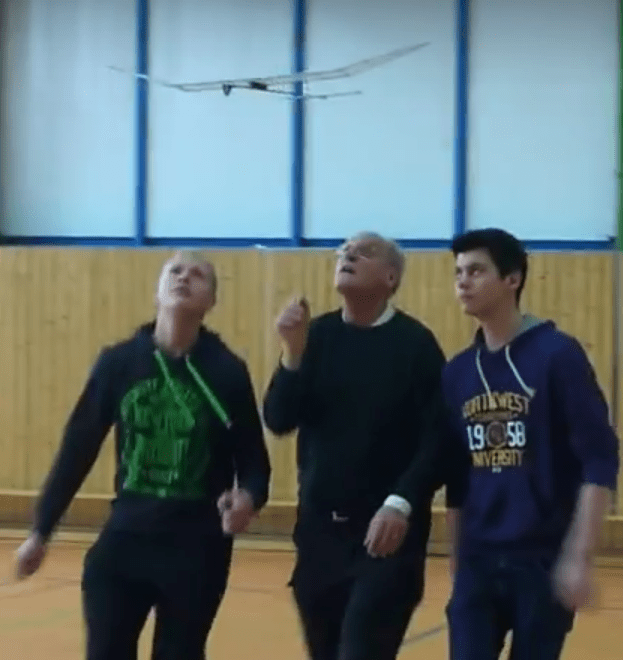
Dr. Heinrich Eder makes breathtakingly efficient gliders and passes his knowledge to young people
Alfred Klinck, also from Germany, is an extrordinary designer, builder and teacher--passing the torch to young people.
Ben Shedd created the Academy Award winning Flight of the Gossamer Condor effort and documented the first walkalong gliders that Tyler MacCready flew.
Peter Sripol took walkalong gliders in new directions.
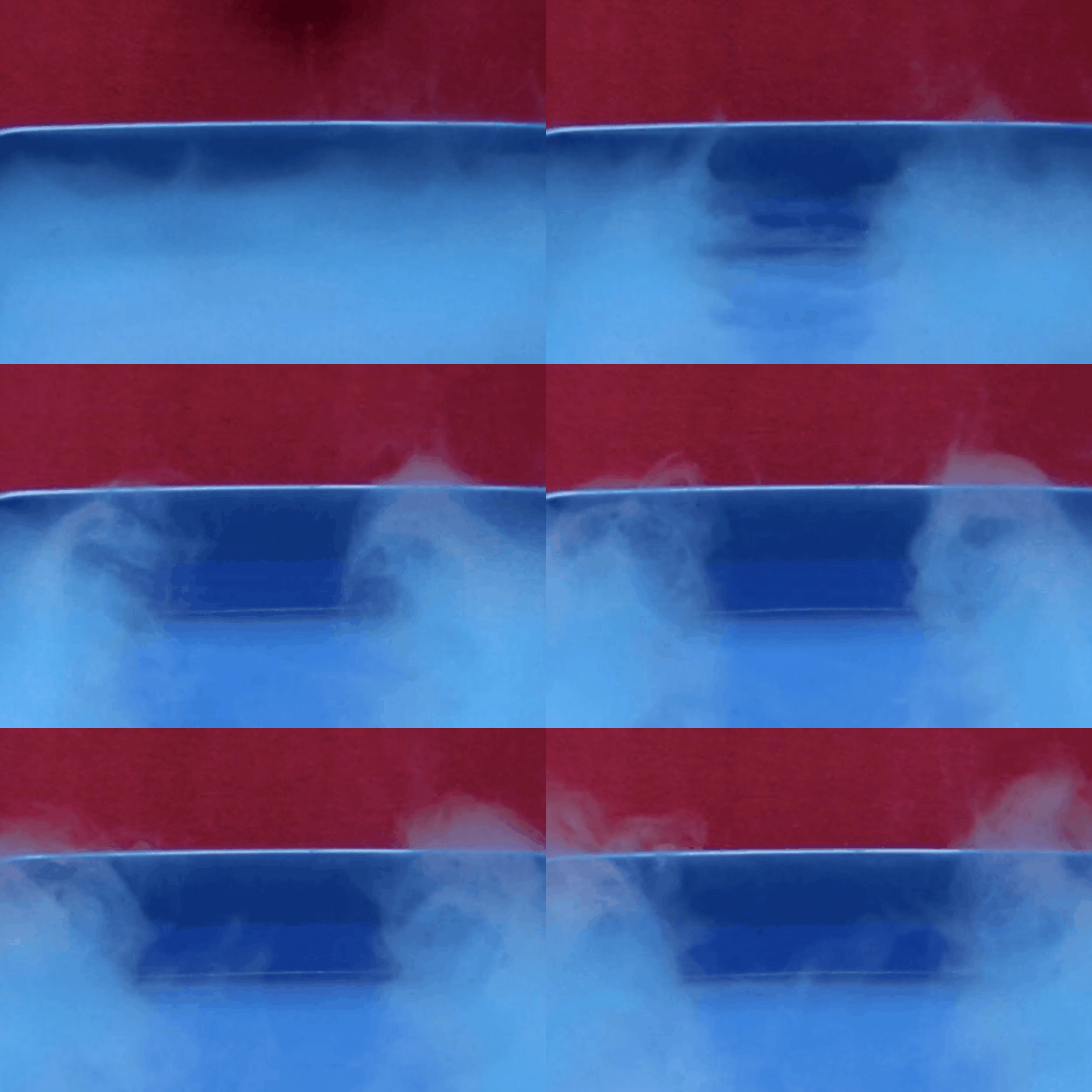
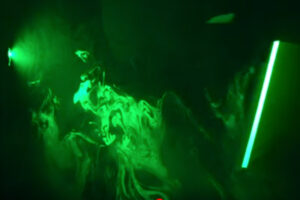
Nick Schrader has done some really good work with visualizing what’s happening in the air around gliders–including walkalong gliders–using fog, and then fog and lasers!
A memorable gathering of walkalong glider innovators in St. Louis in 2010, including many people on this page.
Here is an early video as I was beginning to discover the history of walkalong flight.
Great Innovators from Around the World
Here are some other great innovators from around the world. Perhaps we will have an international gathering sometime and I will be able to interview them.
Germany
Here's some more great work from Germany (and some joking at the very end)
Thomas Buchwald, a teacher in Germany showed me a new way to make a tumblewing, the quickest and simplest I have seen.
Here is Thomas Buchwald again with a smooth flying foam glider with a V tail.
Taiwan
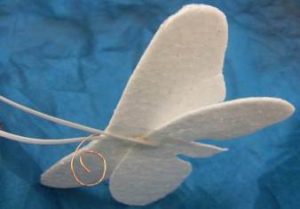
From Taiwan making beautiful flying butterflies from foam
Daryl Yeh from Taiwan has a wonderful YouTube channel with many beautiful videos of people flying "indoor kites"--lightweight, slow-flying, powered by hand. Here he plays a joke. It's a walkalong glider...no, wait? It's an indoor kite! Funny yes, ingenious too. Perhaps this is a way for walkalong glider people to experience indoor kite flying.
This primary school teacher named Chen Wenhwa is doing interesting things with foam gliders that look like birds and insects. Here are more videos.
From Taiwan, here's the inverse of what Phil Rossoni has done with flying real butterflies, flying his butterfly-shaped foam gliders.
England
Here is an English cellist named Thaddeo Andre who made a walkalong plane from phonebook paper, raw carbon fiber and superglue.
United States
Nyle Steiner is blurring the boundary between walkalong gliders and levitation with static electricity. Note that static electricity projects go better in cool, dry air. Here you can read more about Nyle and static electricity.
Columbia
Alfredo Ramirez of Columbia sent this video of his impressive flight in the Red Bull extreme paper airplane event. Using Thaddeo Andre's design as a starting point, it has good size (= greater efficiency). And I like the dihedral, which might give better stability than my design.
 Check out the flight gallery of people who have sent pictures or posted videos.
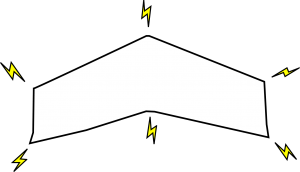 If the glider is attracted to the board, you just need a damp wipe.